ASGM: Beyond Formalization — Creating the Conditions for Responsible Investment
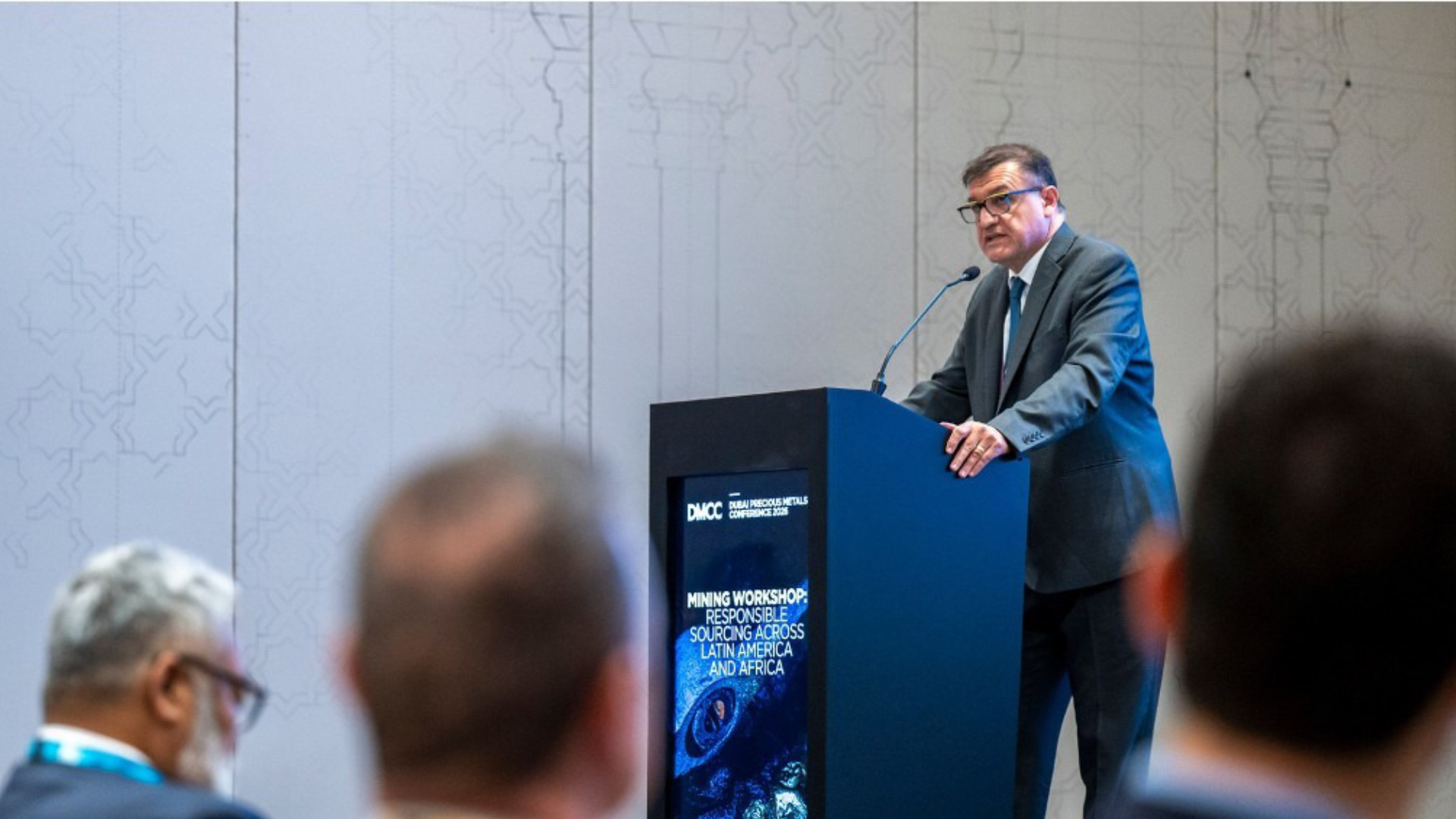
Roger Tissot | Executive Director, Artisanal Gold Council
Assalamu Alaikum.
Good morning, everyone.
It is a real pleasure and an honour to be here today, together with my good friend and colleague Saidou Kabré.
I am particularly pleased to see so many distinguished colleagues and experts in the room Above all, I would like to thank the DMCC for its kind invitation and for the confidence it has placed in AGC by involving us in the preparation of this forum.
I must confess that I would find it rather pretentious to stand before this audience and present what I consider to be the vision or the roadmap for artisanal and small-scale gold mining.
After all, I am a relative newcomer to the sector, having spent only four years as Executive Director of AGC. Many of you have dedicated entire careers to understanding and addressing its challenges.
But perhaps being a relative outsider gives me the freedom to ask a few uncomfortable questions.
And the question I want to raise today is rather simple:
"Are we trying to formalize artisanal miners, or are we trying to create the conditions that allow them to become responsible, productive and economically sustainable miners?"
Because I am not convinced these are necessarily the same thing.
1. Formalization: An institutional problem
Throughout much of my professional life, first as a student and later in my career, I have been interested in one fundamental question: What is the role of institutions in economic development?
And I can think of few institutional challenges more complicated than what we call the formalization of artisanal and small-scale gold mining.
We talk endlessly about formalization. Governments promote it. Development agencies finance it. NGOs implement projects around it. And the private sector increasingly demands it.
But formalization for what purpose? And for whose benefit?
Historically, particularly in Africa, governments initially approached formalization as a way to reduce gold smuggling, bring production into official channels and capture a greater share of mineral revenues through taxes and royalties.
In other words, ASGM was viewed primarily as a source of public revenue.
International development institutions subsequently approached artisanal miners as potential micro-entrepreneurs who, with some training, technical assistance and access to finance, could become productive small businesses.
Then environmental considerations became increasingly important. Formalization was presented as a pathway toward reducing mercury use, improving environmental performance and promoting sustainable development.
All perfectly legitimate objectives.
But there is a problem.
We have been asking formalization to accomplish many different things, without always considering whether the institutions we have created are capable of delivering them.
And perhaps more importantly, without sufficiently asking the miners themselves what they need and what they can realistically accomplish.
2. What do the miners actually want?
I recently read an excellent paper published in 2025 by Professor Gavin Hilson and his colleagues, examining whether formalization actually facilitates environmental improvements in artisanal and small-scale mining.
Their research, particularly in Ghana and Liberia, raises a rather uncomfortable question.
Formalization can indeed contribute to better environmental practices. Licensed miners are easier to monitor, have greater security of tenure and are often more willing to invest in improving their operations.
But the institutional systems designed to formalize them were frequently created for entirely different purposes.
And in many cases, those systems have become so expensive, bureaucratic and complicated that they actually discourage miners from entering the formal economy.
In other words, we have created systems intended to encourage formalization that sometimes make formalization practically impossible.
This resonates very strongly with what I have observed during my four years at AGC.
I have met miners, cooperative leaders and traditional community authorities across different countries.
And my experience has been that most miners are receptive to learning how to improve their operations.
They want better technology. They want to recover more gold. They want safer working conditions. And when they understand the consequences of mercury pollution, many are willing to consider alternatives.
Of course, they also want to earn a living. We should never forget that.
For many of these families, gold mining is not an entrepreneurial adventure. It is a means of survival.
And this brings me to what I consider the fundamental economic problem.
3. The economic reality: Market-ready versus non-market-ready ASGM
We operate in a market economy.
And in a market economy, investment decisions ultimately depend on expected returns and risks.
Investors are not charities. Nor should we expect them to be.
Contrary to what some people believe, responsible investors are generally quite risk-conscious.
They want reasonable security of mineral rights, environmental permits, predictable production, adequate infrastructure and, perhaps most importantly, some credible understanding of the mineral resource.
Without those conditions, it becomes very difficult to justify an investment.
Unfortunately, obtaining them is far beyond the financial and institutional capacity of most artisanal mining communities.
So I have developed a rather simplistic way of looking at the ASGM universe.
I divide it into two broad categories:
Market-ready and non-market-ready communities.
Market-ready communities are those that have secured, or have a credible pathway toward securing, mining rights and environmental permits.
They have some organizational structure, reasonably consistent ore and gold production, access to infrastructure and enough geological information to support an investment decision.
These communities can be very attractive to private investors and processing plant providers.
With improved technology, better recovery rates and more efficient operations, the economic returns can be substantial.
And I welcome private investment in these communities.
But I suspect they represent only a relatively small proportion of the ASGM universe.
So what happens to everybody else?
4. The forgotten majority
The non-market-ready universe is enormous and extremely diverse.
At one end are mining communities that have operated in the same areas for years, sometimes generations, but lack the financial resources, geological information, technical capacity or institutional support required to become formal and attract investment.
Some cannot obtain mining licenses because the procedures are too expensive or complicated. Others lack adequate leadership or organizational structures.
Many work from day to day, following geological indications, experience, tradition and sometimes simply rumours of a new gold discovery.
At the other extreme are operations in prohibited areas, such as national parks, or regions controlled by criminal organizations and armed groups.
Obviously, these situations require very different responses. I am certainly not suggesting that NGOs or development agencies should finance illegal operations in protected areas or support criminal networks.
But between these extremes lies a vast population of miners who have genuine potential to improve their livelihoods and environmental practices, provided they receive the appropriate support.
And this population is growing.
High gold prices create powerful incentives to enter mining. In many African countries, agricultural livelihoods are under pressure, including from climate change. Demographic growth and limited rural employment opportunities are pushing increasing numbers of people toward ASGM.
We can debate whether we like this reality.
But we cannot simply wish it away.
For millions of people, ASGM is not an investment choice. It is an economic necessity.
And these are precisely the communities where AGC wants to concentrate its efforts.
5. The role of NGOs and the private sector
A couple of years ago, during a meeting in Toronto, a good friend from the LBMA made a comment that stayed with me.
He suggested that NGOs had spent years trying to address the challenges of ASGM, with rather disappointing results, and that perhaps it was time for the private sector to take a much more active role.
At the time, I was relatively new to AGC, and I must admit I felt a little accused!
But after thinking about it, I realized he was right.
At least partially.
The private sector absolutely must become more involved.
We need private capital, commercially viable processing facilities, responsible gold buyers, better technology and stronger supply chains.
And I welcome the increasing interest from organizations such as the World Gold Council and many of the companies represented here today.
But there is a fundamental limitation.
If private investment concentrates exclusively on market-ready ASGM communities, we will undoubtedly create some successful projects.
We may even have excellent examples of responsible gold production and commercially profitable processing plants.
But what happens to the much larger population of miners who are not yet market-ready?
We will continue to see mercury pollution, environmental degradation, unsafe working conditions, informal gold trading and the social conflicts associated with poorly regulated mining.
We will have improved a small part of the sector while leaving the fundamental problem largely untouched.
And this is where I believe NGOs such as AGC have a distinct and essential role.
Our job should not be to compete with private investors.
Our job should be to help create the conditions that make responsible private investment possible.
We need to work with communities that have genuine potential but are not yet attractive to investors.
Help them improve their technical capabilities, introduce mercury-free processing, strengthen their organizations, navigate permitting requirements, and develop a better understanding of their mineral resources.
In other words, we need to de-risk these communities so that some of them can eventually become market-ready.
And those that cannot become commercially attractive in the foreseeable future may still justify support because of the environmental and social benefits that can be achieved.
Reducing mercury emissions, improving miners' incomes, protecting water resources and creating safer working conditions are legitimate development returns, even if they do not immediately generate attractive financial returns.
6. Who finances the transition?
And here we come to the uncomfortable part.
All of this requires resources.
Resources that artisanal miners generally do not have.
Resources that private investors, understandably, are reluctant to commit before the risks have been sufficiently reduced.
And resources that international development agencies and philanthropic organizations are increasingly reluctant, or unable, to provide.
This creates a fundamental financing gap.
We expect communities to become formal, responsible and commercially attractive before they can access financing.
But they need financing and institutional support precisely to become formal, responsible and commercially attractive.
It is a classic chicken-and-egg problem.
And unless we find a way to bridge that gap, we will continue to organize conferences, publish excellent reports, launch ambitious initiatives and celebrate isolated successes, while the broader problems of ASGM continue to grow.
I believe this is where the large gold mining industry, responsible gold buyers, development institutions and organizations such as AGC must work together.
Not through permanent subsidies or charity, but through targeted investments in the transition toward responsible mining.
Some communities will eventually become attractive to private capital.
Others may never reach that threshold, but the social and environmental returns can still justify the intervention.
And let us not forget that the large gold mining industry also benefits when the negative environmental, security, reputational and social impacts associated with informal ASGM are reduced.
Responsible coexistence is not simply about a large mining company taking care of a few artisanal miners in its neighbourhood.
It is about creating the institutional and economic conditions in which both sectors can operate more responsibly and with fewer conflicts.
7. Conclusion: A challenge to all of us
Let me conclude with one thought.
I do not believe the central challenge of ASGM is a lack of willingness among miners to improve.
Nor is it simply a lack of technology. Much of the technology already exists.
The real challenge is creating institutions, incentives and financing mechanisms that allow miners to adopt better practices and make them economically sustainable.
Formalization is important. But formalization should be a means to an end, not an end in itself.
And the end should be very clear:
More productive mining, better livelihoods, less mercury, less environmental destruction and communities that can participate responsibly in the formal economy.
If we concentrate exclusively on miners who are already attractive to private investors, we will achieve some successes.
But if we want to make a meaningful difference to the ASGM sector as a whole, we must also be willing to invest in those who are not yet market-ready.
That is where the challenge lies.
That is where I believe AGC has an important role to play.
And that is where I hope this forum, and the partnerships emerging from it, can make a genuine difference.
Thank you.


Related Posts